Sunday, November 11, 2018

Book Launch: Postcolonial Intellectuals in Europe: Critics, Artists, Movements, and their Publics, ed. by Sandra Ponzanesi and Adriano José Habed

  5-6 February 2019

Among the confirmed speakers/contributors: 

Bolette B. Blaagaard, Rosemarie Buikema, Gianmaria Colpani, Adriano Jose Habed, Wigbertson Julian Isenia, Koen Leurs, Jamila M. H. Mascat, Ana Cristina Mendes, Sandra Ponzanesi, Mehdi Sajid, Neelam Srivastava, Jesse van Amelsvoort.Special guest: Rosi Braidotti.
Postcolonial intellectuals have engaged with and deeply impacted upon European society since the figure of the intellectual emerged at the beginning of the nineteenth century. Yet a critical assessment and overview of their influential roles is long overdue, particularly in the light of contemporary debates in Europe and beyond.With interventions by Engin Isin, Gayatri C. Spivak and Bruce Robbins. Read more here. 
Practical information
Date: 5-6 February 2019
Time: 15.00 - 18.00
Location: Drift 21, room 0.05 Sweelinckzaal (entrance drift 27)

Sunday, June 24, 2018


 CONFERENCE REPORT NOW AVAILABLE:

Migration and Mobility in a Digital Age: Paradoxes of Connectivity and Belonging


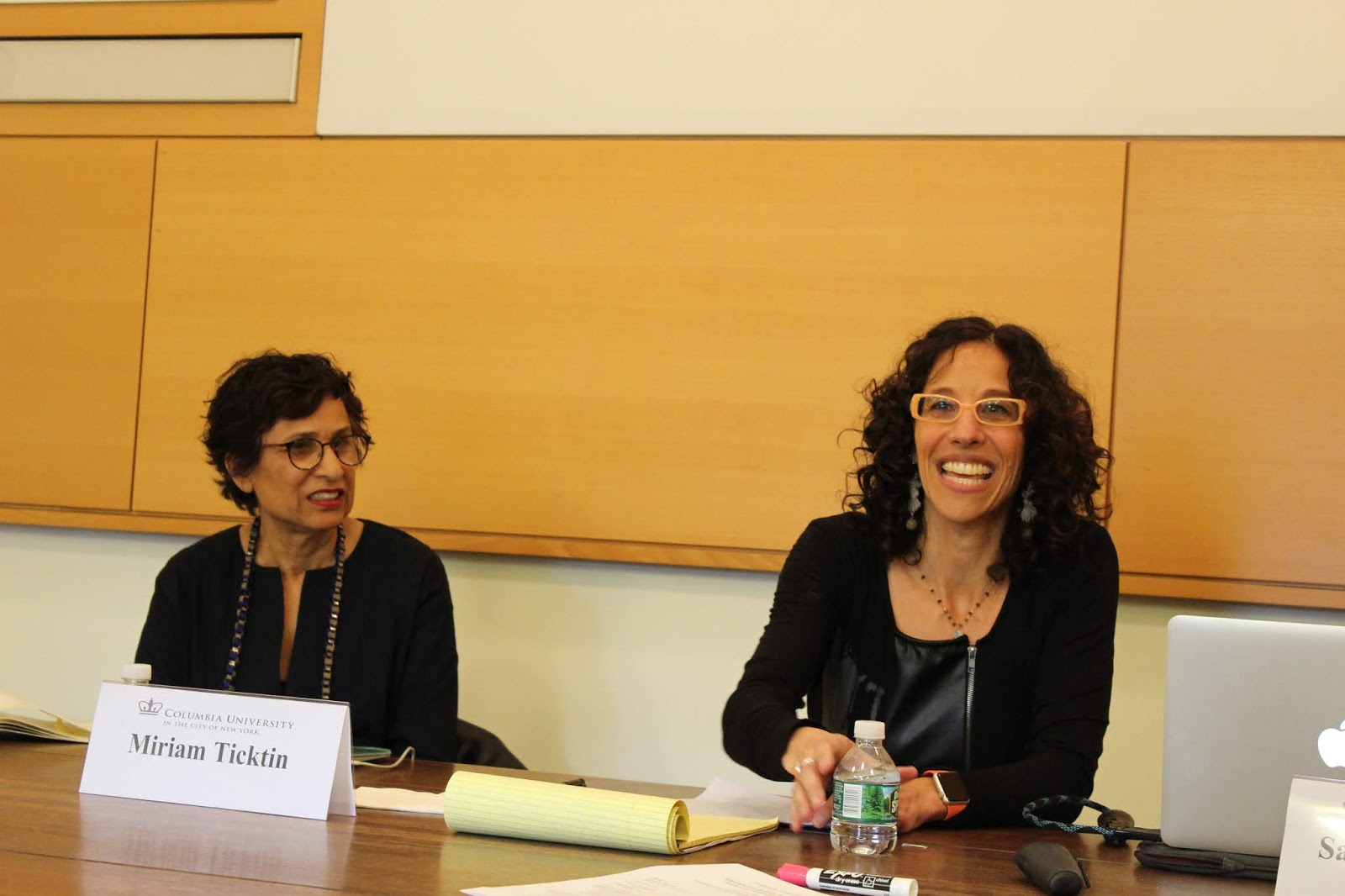
In April 2018, a two-day international conference was held at Columbia University, hosted by the Heyman Center for the Humanities. The event was made possible through co-sponsorship by many units at Columbia University, including the Division of Humanities and the Department of English and Comparative Literature, and other universities in NYC (NYU-MCC and New School-Zolberg Institute) along with European partners. The conference, entitled “Migration and Mobility in a Digital Age: Paradoxes of Connectivity and Belonging,” brought together many international scholars who have been working at the intersection of media and migration for many years from an interdisciplinary and international perspective. The conference was opened with words of welcome by the Dean of Humanities Sarah Cole. The organizer Sandra Ponzanesi introduced the themes and goals of the conference and highlighted the major strands of the seven panels and closing two keynote addresses. READ THE FULL REPORT HERE


VISIT THE CONFERENCE PHOTOGALLERY HERE


INTERNATIONAL CONFERENCE

Columbia University
The Heyman Center for the Humanities

Migration and Mobility in a Digital Age: Paradoxes of Connectivity and Belonging

Tuesday, April 10, 2018 - Wednesday, April 11, 2018


Organizer

Sandra Ponzanesi
  •  Visiting Professor, Department of English and Comparative LiteratureColumbia University/Professor Gender and Postcolonial Studies, Utrecht University.

Keynote Speakers

Arjun Appadurai
  • Paulette Goddard Professor of Media, Culture, and Communication, New York University 
Mirca Madianou
  • Professor in the Department of Media and Communications Goldsmiths, University of London
Check the full list of speakers here: 


The image of Syrian refugees with a smartphone shooting ‘selfies’ upon reaching dry land has captured the international imagination (Chouliaraki, 2017; Kunstman, 2017; Risam, forthcoming 2018). It suggests an image of the ‘connected migrant’ (Diminescu, 2008), which is shaped by a profound ambivalence: migrants are expected to be people fleeing from war, violence, and poverty; they are not expected to be ‘digital natives’, equipped with technologies to navigate their difficult journeys. While smartphones are accessible, affordable, and easy to use, in the realm of the public imaginary the image of the disenfranchised and disconnected migrant remains that of the ‘have nots’, and therefore subject to ‘high tech orientalism’ (Chun, 2006, p. 73). This posits the figuration of the migrant as outside the realm of development and modern forms of communication, disenfranchised and vulnerable in order to be worthy of international aid and pity (Boltanski, 20000; Ticktin, 2008). And yet smartphones are ubiquitous, and migrants have been early adopters and heavy users of technologies for the simple reason that these technologies are ingrained in their daily practices and everyday lives, which often involve perilous crossings but also the need to keep in touch with the home front and their diasporic communities. The promise of connectivity that is guaranteed even under duress becomes fraught with the profound disconnection brought about by the disciplining gaze of Western media and publics.
It is, therefore, crucial to focus on the specific way in which digital technologies bridge or magnify the gap in migration between geographical distance and digital proximity. How are affect, intimacy, and belonging negotiated online in the face of forced migration and expulsions (Sassen, 2012) but also of circular migration, expatriation, and transnational movements?
This conference aims to cover a broad range of conflict-related issues on migration in a digital age. Using the latest insights from a range of interdisciplinary fields, it will explore theories of displacement such as diaspora, cosmopolitanism, and nomadism, and the transformations brought about by the digital revolution, through the analysis of virtual communities, social media platforms, and digital activism. It will also focus on media production and the regulation of information on forced migrants in a ‘post-truth’ era: fake news; the humanitarianism-securitization nexus, migration management, social and political conflicts related to migrant and diaspora communities, radicalization and online counter-terrorism, hate speech and racism, but also solidarities, activism, and protest.
For more info e-mail Sandra Ponzanesi: sp3630@columbia.edu
Or follow the link updates on the programme and schedule:
http://heymancenter.org/events/migration-in-a-digital-age-paradoxes-of-connectivity-and-belonging/

The conference is a collaboration between Columbia University, Heyman Center for the Humanities, and the ERC project ConnectingEurope and other co-sponsors (Columbia University, Division of Humanities, New York University, The New School, IRWGS, Council for European Studies etc..)


Tuesday, October 24, 2017

Conference
Fourth Annual ACGS Conference - Amsterdam 26-27 October 2017

Postcolonial Mediations: Globalisation and Displacement


Keynote speakers

  • Victoria Bernal (Professor of Anthropology, University of California, Irvine, US)
  • Paula Chakravartty (Associate Professor Media, Culture and Communication, New York University, New York, US)
  • Iain Chambers (Professor of Cultural and Postcolonial Studies, Oriental University, Naples, Italy)


Postcolonial Mediations

Postcolonial thinking has challenged the stability of discourses on culture, globalisation, economics, human rights and politics. Postcolonial thinking, as a form of mediation and displacement of worldviews, triggered a re-evaluation of the complex connections between culture, class, economy, gender and sexuality. This conference aims to engage with such postcolonial displacements.

Displacement can be seen under the rubric of mobility and its many forms today, most tellingly discernible in the forced movements of peoples in the wake of wars, and the concomitant crises this provokes around issues of “culture and civilization”, and its gendered, religious and raced dimensions. The refugee crisis in Europe is an important case in point. Cultural productions from the non-West continue to displace received understandings of other cultures and societies (Chow, 2002, Narayan, 1997) while contemporary political movements draw inspiration from postcolonial struggles as they deploy new media forms, as Howard Caygill (2013) has recently shown in his analyses of the Gandhian non-violence movement, the continuing Maoist rebellions and their relation to the Zapatistas and the Indignados. The shifting contours of gender and sexual politics, and the critique of stable identities provoked by queer politics and theory, are also producing displacements, in the discourse and practice of the politics of rights. Local, regional and national politics often challenge universal rights claims. e.g. the controversies around the relevance of “Global Queer” (Altman, 1996).

The postcolonial is understood here simultaneously as a mediating and a displacing series of interventions, which demands engagement with contemporary understandings of globalisation.

for more information about the programme see here: 

Organisers

Sudeep Dasgupta (University of Amsterdam), John Nguyet Erni (Hong Kong Baptist University), Aniko Imre (University of Southern California), Jeroen de Kloet (University of Amsterdam), Sandra Ponzanesi (Utrecht University), Raka Shome (National University of Singapore)

Location

University Theatre

Nieuwe Doelenstraat 16-18 | 1012 CP Amsterdam
+31 (0)20 525 2997